By: Benjy Behrman
Planning Yuval Yisrael 2026 was not easy! The war with Iran at the beginning of the year made it virtually impossible to plan for the summer. Most of the country was shut down, and it was unclear whether we would be able to fly our teens into Israel. However, with the ceasefire in April, we were determined to ensure that Yuval Yisrael would happen. For the USYers who were committed to Yuval this summer, there was no way we wouldn’t ensure they had an unforgettable, joyous, safe, and meaningful summer in Israel.
The reason why it is so important to us at USY that we have a summer program in Israel is that we recognize how challenging it is for our teens to be proud Zionists and supporters of Israel in the current political climate. It is essential that our teens develop their own meaningful relationship with Israel. Our teens must discover for themselves why it is worth standing up for Israel. They must develop their own relationship with Israel. To make this happen, our educational approach was not to provide a one-dimensional understanding of Israel. We wanted to provide our teens with different streams (Yuval is Hebrew for “stream”) that could help them connect with Israel. This was not about Israel advocacy. This was about Israel discovery: discovering for ourselves why Israel is important to us as the Jewish people.
The first Yuval, or stream, was exploring the Jewish past in our ancient homeland. We focused on our people’s deep roots and history in the Land of Israel. While we explored our history chronologically, our goal was never just a history lesson. Instead, we used every ancient stone and historic site as a launchpad to discuss the living Jewish values that continue to shape who we are today.
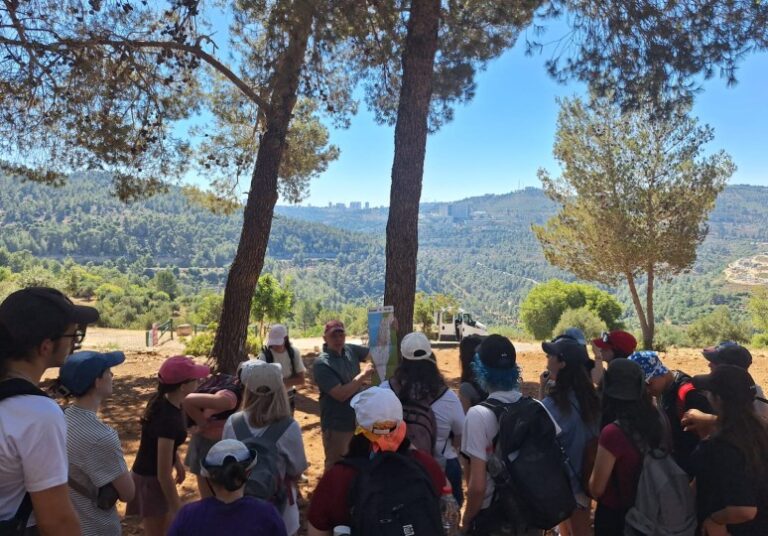
We began with a hike through the Sataf archaeological site, sitting on stone terraces that have stood for thousands of years, as we explored the Torah’s agricultural laws, the background to the Book of Ruth, and its message of generosity and responsibility. This was the ultimate backstory to King David. Later that day, we sat beneath the ruins of King David’s palace, sang “David Melech Yisrael,” and had a surprisingly raw conversation about leadership. Do we expect our leaders to be perfect, or do we embrace them as human beings who sometimes fall short?
Our next historical journey took us to the Second Temple period. From the Israel Museum to the Kotel Tunnels and the Southern Wall excavations, we explored the relationship between sacred spaces and the values of the people who built them. If a society doesn’t live up to its ideals, does it still deserve its holiest places? That conversation carried naturally into a meaningful mincha service at the egalitarian Kotel.
After an archaeological dig and celebrating Shabbat in Jerusalem, we focused on how the Jewish people respond to tragedy. We crawled through the Bar Kochba tunnels, debated Rabbi Akiva’s legacy, and then, before most of Jerusalem had even hit the snooze button, climbed Masada to watch the sunrise.
Looking at the ruins of the synagogue, school, and mikvah (ritual bath), we realized something powerful: these Jewish refugees went to Masada to live, not to die. As I told the teens on top of Masada, now that we have a modern Jewish homeland, the question changes. It’s no longer simply, “how do we survive?” Instead, we ask: “What kind of Jewish life do we want to create? What values will guide us today?”
That was our first Yuval, and it gave us an opportunity to ask whether it is our past in this land that makes Israel so important to us as the Jewish people.
The second Yuval of the program was connecting to the land of Israel. We achieved this by traveling through both the north and south of the country.
Here are some of the highlights:
- Harvesting potatoes for families in need
- Experiencing Druze hospitality in the village of Isfiya
- Hiking in the Gilboa Mountains
- Swimming in the beautiful springs of the Sachne
- Swimming in the Kinneret
- Dancing on a disco boat on the Kinneret
- Visiting David Ben-Gurion’s desert home and grave
- Sleeping under the stars in Machtesh Ramon
- Snorkeling in the corals of Eilat
For me, the most meaningful moment was learning about the young pioneers of the Second Aliyah at the Kinneret Courtyard Farm. These young Jews came to Israel לבנות ולהבנות – “to build and be rebuilt” – defining a revolutionary way of living a Jewish life of self-sufficiency and independence in the Land of Israel. We learned the stories of six incredible women who embodied this revolution, each contributing in her own pioneering way to the development of our people:
- Sarah Malkin, a founding member of the Kinneret settlement
- Miriam Baratz, a founding member of the first kibbutz, Degania, who, in her diary, described leaving her own wedding celebration to milk the cows!
- Chana Meisel, who established an agricultural training school for women
- Rachel the Poetess, one of the greatest poets of modern Hebrew literature
- Naomi Shemer, Israel’s greatest songwriter
- Shellie Greensbum, a feminist trailblazer for the Conservative/Masorti community, was buried in the Kinneret cemetery
These remarkable women inspired us to consider what our own contributions to the Jewish world can be.
The third and final Yuval was connecting to the people of Israel. We spent time in Tel Aviv, exploring the city’s original neighborhoods and discussing the nature and challenges of the first Hebrew city. We discussed the idea of Jewish peoplehood at the ANU museum and honored the memory of USY alum Omer Neutra z”l by visiting his grave. We also explored the challenges facing Israel’s security. We met with both a Palestinian and a Jewish Settler from the West Bank and spent time in the Gaza Envelope, in which we both honored the memory of those who were tragically killed on October 7th and discussed the implications for Israel and the Jewish world as a result of the October 7th war.
All these tremendous experiences were aimed at helping our teens develop their own complex, personal relationship with Israel, Zionism, and their Jewish identity.
As I reflect on the experience, I believe that every member of the group had a transformative experience as part of a caring and joyous community. All of this could only be achieved through the dedication of the USY Yuval Yisrael staff and the entire Ramah Israel team.